|
Shavuot
Shavuot, Festival of Weeks * Chag
Ha'Bikurim, Holiday of the First Fruit * Z'man Matan Torateinu,
Time of the Giving of the Torah 
Shavuot,
the Festival of Weeks, corresponds to the 6th and 7th of Sivan.
The many names of the holiday best describe exactly what is celebrated:
Shavuot,
Festival of Weeks - Shavuot is the only holiday not listed
in the Torah by the day and month on which it is to be observed.
Rather, the Torah instructed that this festival take place the 49th
day after the second day of Passover, the day on which the Omer
Sacrifice was offered. The name, therefore, reflects the fact that
this holiday occurs seven complete weeks (shavuot) after Passover.
In mystical terms, the number 7 represents the natural order of
things, and so a complete, natural cycle has occurred.
Chag Ha'Bikurim, Holiday of the First Fruit
- The natural cycle that has been completed is agricultural.
On Chag Ha'Bikurim, the offering of the First Fruit of the harvest
was brought to the Holy Temple in Jerusalem as a gesture of thanksgiving
for the successful yield.
Z'man
Matan Torateinu, Time of the Giving of the Torah - But Shavuot
takes place one day after the seven weeks, which is one step beyond
the natural cycle and is, therefore, also representative of a supernatural
event as well. On Passover, we celebrate the miraculous Exodus of
the People of Israel from Egypt. The Israelites at the time, however,
were, at best, a family, a loose assortment of cousins bonded together
by their mutual misery. At the end of seven weeks, however, at the
base of Mount Sinai, the former slaves rose above their human limitations
and, by accepting the Torah, took upon themselves a total commitment
to G-d, thus creating the Nation of Israel. Shavuot is therefore
also known as Z'man Matan Torateinu, the celebration of the giving
of the Torah
LAWS AND CUSTOMS Shavuot is a low-key,
pensive holiday, unlike Passover with its long Seder nights and
crunchy, matzah-filled days. The following are the general laws
and customs for the holiday of Shavuot:
I. FESTIVAL LAWS
Candle lighting
Shabbat and all Jewish holidays always begin at sunset of the
evening before. On the Sabbath and Yom Tov [festival] candles
are lit 18 minutes before sunset to welcome the holiday.
Two candles (minimum) are lit, then both hands are waved towards
the face, symbolically drawing in the light of the candles and
the sanctity of the Sabbath/Yom Tov. The eyes are covered and
the blessing is recited.
|
Baruch
atah Ado-nai, Ehlo-haynu Melech Ha-olam, asher kideshanu
b'mitzvotav v'tzeevanu l'hadlik ner shel Yom Tov.
|
|
Blessed
are you L-rd, our G-d, Ruler of the world, who sanctified
us through His commandments and commanded us to kindle the
lights of Yom Tov (festival).
|
An additional blessing, Sheh'heh'cheh'yanu, is pronounced
to acknowledge the good fortune of being able to experience the
holiday:
Baruch
atah Ado-nai, Ehlo-haynu Melech Ha-olam, sheh'heh'cheh'yanu
v'kee'manu v'hee'gee'anu la'zman ha'zeh
|
|
Blessed
are you L-rd, our G-d, Ruler of the world, Who has kept
us alive, sustained us, and brought us to this season..
|
Evening services are held in the
synagogue.
A festive meal is eaten, preceded
by the Festival Kiddush, ritual washing of the hands and Ha'Motzee,
which is made over two whole challot. The meal is followed by
the Grace After Meals with the addition of Y'aleh V'Yavo,
"May there rise and come...", in honor of the holiday,
and the Harachamon for the festival.
Changes in the morning synagogue service
-
During Shacharit,
the morning service, the Festival Amidah is recited.
-
Hallel
-
Hallel is a collection of Psalms that are recited on the
festivals and Rosh Chodesh (the new month).
- Hallel
can be found in the siddur (Jewish prayerbook).
- The
Book of Ruth is
read on the last day of the holiday (see below for details).
-
The Torah Reading
-
On the first day of Shavuot, Exodus 19:1-20:23 is read in
synagogue.
On the second day of Shavuot, Deuteronomy 14:22-16:17 is
read in synagogue.
- The
maftir (additional reading) on both days is Numbers 28:26-31.
-
The haftorah (prophetic message) on the first day is from
the Ezekiel 1:1-28, 3:12.
The haftorah on the second day is from Habakuk 2:20-3:19.
- Yizkor
- The Memorial Service
-
The Yizkor Memorial Service is recited on the last day of
all festivals -- Passover, Shavuot, Sukkot and on Yom Kippur.
-
While those who have passed away are no longer able to effect
their own spiritual growth, the deeds of their children
may result in additional merit for their souls.
- )
According to some Ashkenazic customs, those whose parents
are both living leave the sanctuary during Yizkor. In Sephardic
custom, everyone remains in the sanctuary while the cantor
recites Yizkor.
E)
A festive meal is eaten, preceded
by the daytime festival Kiddush, ritual washing of the hands and
HaMotzee, which is made over two whole challot. The meal is followed
by the Grace After Meals with the addition of Y'aleh V'Yavo, "May
there rise and come...", in honor of the holiday and the
Harachamon for the festival.
F) Mincha, the afternoon service is
recited with the special Festival Amidah (and the special insertions
for Shabbat, as well as including the weekly Torah reading for
Shabbat Mincha, when applicable).
G) Havdalah - At the conclusion of
the second day of Yom Tov, Havdalah, separating holy days from
week days, is recited in the evening Amidah. This Havdalah is
followed by the formal Havdalah, which consists of only the blessing
over grape juice (HaGafen) and the Havdalah blessing (HaMavdil),
which can be found in the prayer book
II. The Book
of Ruth
is read during the morning service prior to the Torah reading (On
the first day of Shavuot in Israel, and on the second day in the
diaspora). The reasons that we read the Book of Ruth are:
A)
Acceptance of the Torah - The Book
of Ruth is the story of a courageous Moabite woman who took upon
herself the laws of the Torah. Since Shavuot commemorates the
receiving of the Torah by Israel, the story of Ruth's journey
from Moabite princess to the wife of one of Judea's leading citizens,
is an inspiration for all.
B) The Harvest Time - The story of
Ruth takes place during the period of the Counting of the Omer
and culminates at the time of the wheat harvest, which is the
time of Shavuot.
C) King David - According to tradition,
King David, the great-grandson of Ruth, was born and died on Shavuot
III.
Customs:
A)
All-Nighters: To demonstrate our love
for the Torah and our appreciation for G-d's revelation on Mount
Sinai, it is customary to stay up all night either learning, listening
to lectures, or simply discussing Jewish matters.
B) Decorating the Synagogue with greens:
There are several reasons given for this custom:
1) More than just a recognition that Shavuot takes place at the
blossoming time of spring, the custom of decorating synagogues
is related to the Talmudic description of Mount Sinai when the
Torah was given. Although located in the wilderness, Mount Sinai
blossomed with flowers
2) When the Holy Temple in Jerusalem was standing, Shavuot was
the time when Jewish farmers brought their first fruit offerings.
To enhance the beauty of the mitzvah, the baskets containing the
fruit were usually decorated with flowers and greenery. Thus,
one of the names for the holiday of Shavuot is Chag Ha'Bikurim,
the holiday of the first fruits.
C)
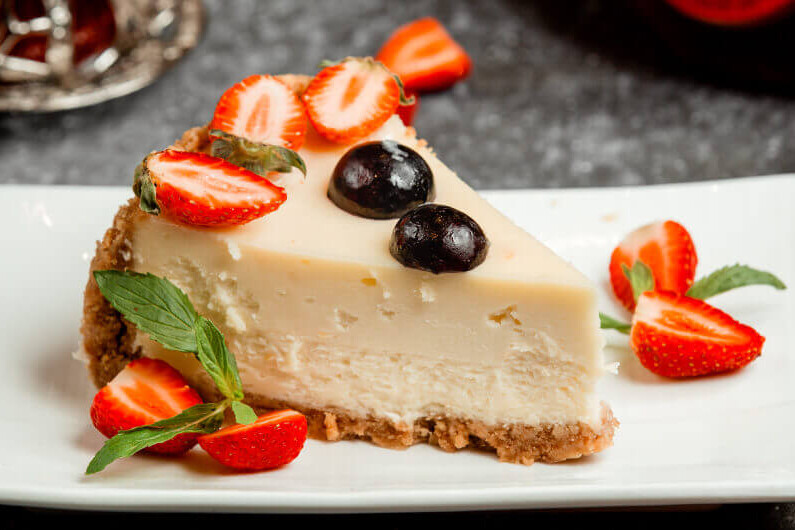
Dairy Foods: On Shavuot, it is customary
to eat dairy foods – cheesecake and blintzes being particular favorites!
Those who have the custom to specifically eat meat meals on festivals
as a sign of joy, usually have a small dairy kiddush and then, after
rinsing their mouths, have a meat meal. Again, numerous reasons
are suggested for eating dairy on Shavuot:
1) Prior to receiving the Torah, the Jews did not know the dietary
laws. Among the first laws that were taught to the Jews were those
of kosher slaughtering. The Jews refrained from meat at that time
until they were able to properly prepare the utensils and learn,
with precision, the laws of shechita, ritual kosher slaughter.
2) In the times of the Temple, Jews celebrated the bounty of the
land on this holiday of the first fruits. Dairy foods represent
the fulfillment of G-d's promise to bring the Israelites to a
land "flowing with milk and honey."
3) The Song of Songs, written by King Solomon, has been interpreted
as a love song between G-d and the Jewish people. Chapter 4, verse
11 reads: "...honey and milk are under thy tongue," an allegory
for the sweetness of learning Torah.
4) On more mystical level, the gematria (numeric value of the
letters) of the word chalav, milk, is 40, which corresponds to
the forty days and nights that Moses spent on Mount Sinai learning
the Torah.
|